Children and Gadgets in Israel: How Schools Limit Smartphone Use
Why the Topic of Smartphones in Schools Has Become Especially Relevant
The smartphone long ago ceased to be just a means of communication: for Israeli schoolchildren, it is both a learning tool, a window into social networks, and a constant source of notifications. Parents in Israel are increasingly asking where the line lies between useful use of technology and harm to attention, sleep, and face-to-face communication. Schools respond differently: some introduce a complete ban on phones during the school day, others allow use only during breaks or for educational purposes. These differences raise many questions for families — from classroom order to the safety of the children themselves. Open information and convenient platforms for sharing experience help to understand the approaches, grasp the arguments of both sides, and find practical solutions. This is where a classifieds service with automatic translation into four languages is especially useful, because Russian-speaking, Arabic-speaking, Hebrew-speaking, and English-speaking families in Israel live side by side and face the same problem.
What Models of Restrictions Israeli Schools Apply
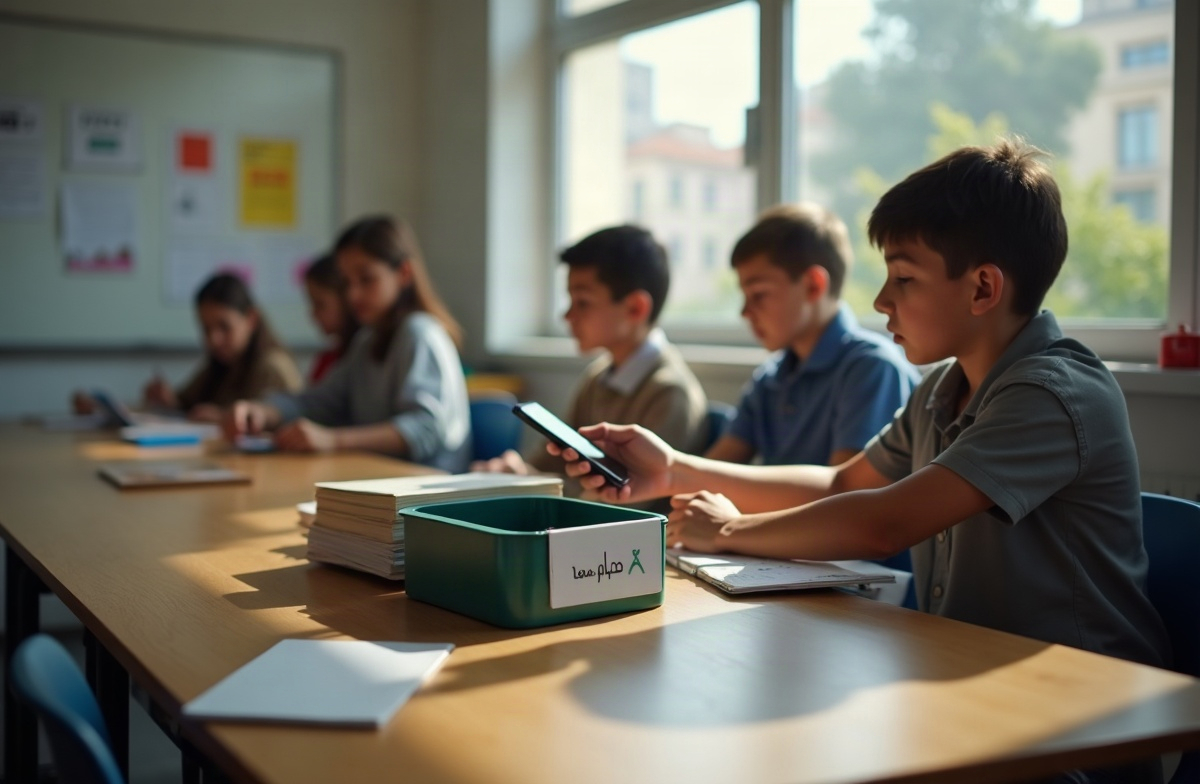
In Israel, there is no single nationwide rule that would prescribe the same phone use regime for all schools, so policy is formed at the level of individual institutions and is often enshrined in internal regulations. In practice, three main models are found. The first is a complete ban: the phone is handed in at the start of the day to a special box or remains in a locker until the end of classes. The second is partial restrictions: devices are allowed only during breaks or exclusively in lessons with educational tasks. The third is a “soft” approach, in which the school relies on students’ awareness and cooperation with parents. Many educational institutions additionally ask parents not to call their children during lessons, but to contact them through the office if the matter is urgent.
It is important to understand that such measures concern not only discipline. Schools cite research on the impact of screen time on concentration, cases of bullying in messengers, and the need to protect children’s personal data. Parents who are looking for options for additional education, clubs, or part-time work for teenagers should keep in mind work — there you can find current offers, and ads are automatically translated into the desired language, which is convenient for families with different native languages.
Arguments of Parents and Teachers: Where Is the Balance
The discussion about smartphones in school is rarely clear-cut. Supporters of strict restrictions point to an improved classroom atmosphere, a reduction in conflicts on social networks, and increased engagement in lessons. Opponents of harsh bans emphasize safety issues: it is important for parents to be in contact with their child, especially if he or she gets to school independently or attends additional classes. There is also a practical aspect — the phone is often used as a means of payment, for accessing schedules and educational applications.
The compromise is most often built around three principles: clear and pre-announced rules, the same for all students; use of phones only for educational purposes under teacher supervision; open dialogue with parents, including an explanation of the reasons for restrictions. The practice of “digital hygiene” at home also helps: agreements on screen time, absence of devices in the bedroom, joint offline activities. Families who are moving or looking for housing near a suitable school often look for options through the real estate section, where translation of ads into four languages allows you to quickly understand the conditions and contact the owner.
Practical Steps for Parents and Schools
For restrictions to work rather than cause resistance, it is useful to act in stages. First, clarify the school’s internal regulations: where exactly phones are stored, what is considered an emergency, what sanctions are provided. Second, discuss the rules with your child in advance: for example, which applications are allowed for study and how to disable notifications during lessons. Third, set up parental controls and “do not disturb” functions so that calls do not distract during lessons. Fourth, agree on communication channels: if you need to convey information urgently, use the school office or the homeroom teacher.
Schools, in turn, are helped by transparency: publication of rules, explanation of their goals, and regular feedback. It is useful to provide alternatives — for example, “digital breaks” with board games or sports activities. For families looking for everyday solutions — from appliance repair to organizing leisure time — services will come in handy, and for buying or selling used devices and school supplies — the second-hand section. Automatic translation of ads into English, Russian, Arabic, and Hebrew makes such platforms convenient for all residents of Israel.
Conclusions and the Convenience of Multilingual Ads
Smartphone restrictions in Israeli schools are not a fight against technology, but an attempt to build a healthy balance between study, safety, and face-to-face communication. Approaches differ: from a complete ban to partial rules and educational use, but the general vector is the same — clear agreements between the school, student, and parents. Practice shows that institutions where rules are announced in advance and are the same for everyone, and where reasonable digital discipline is maintained at home, win out. For parents, the key issues remain contact with their child and understanding school requirements.
Our classifieds service makes finding solutions easier: every posted text is automatically translated into English, Russian, Arabic, and Hebrew, so your ad instantly becomes understandable to the widest audience in Israel — from finding housing and work to services and goods. Publish information in a couple of minutes and receive responses in a language the other person understands — this saves time and expands opportunities for the whole family.