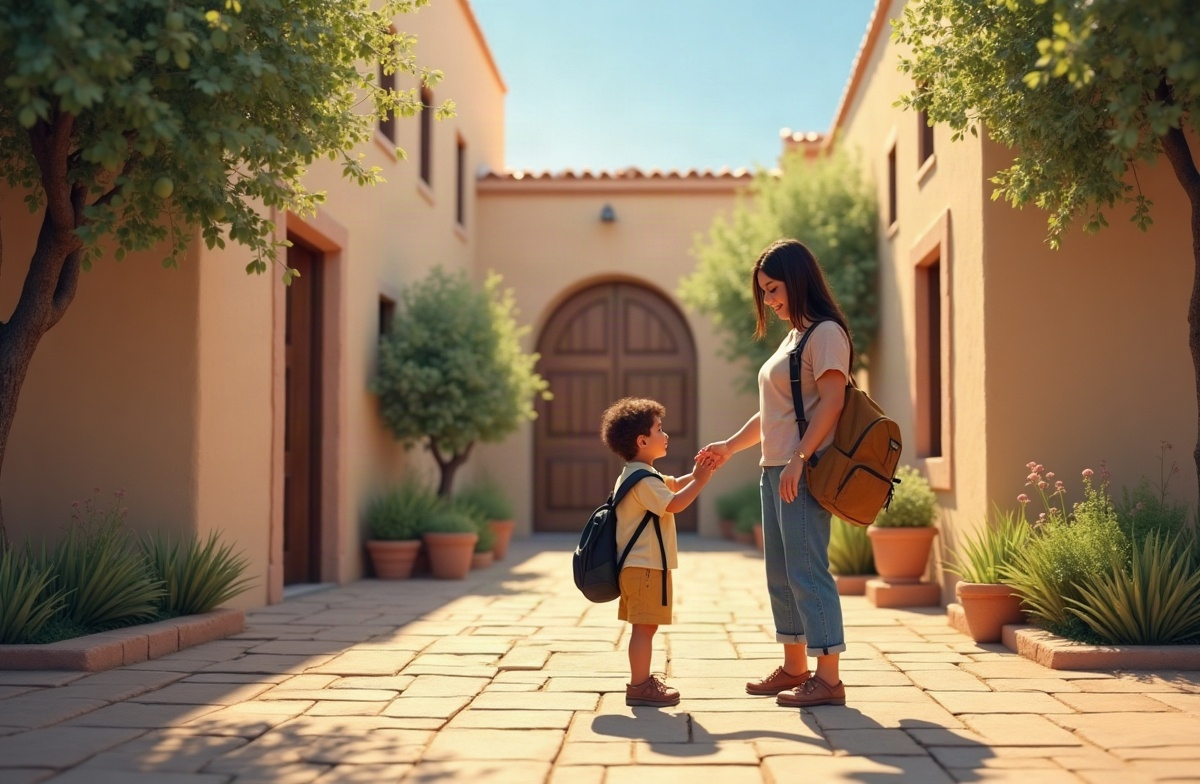
How to Help Your Child Adjust to School Without Hebrew
Moving to Israel is a serious challenge for the whole family, and especially for children who are about to start a new school where instruction is in Hebrew. If your child does not know the language, at first they may feel scared, lonely, and overwhelmed. Parents often don’t know where to begin: whether a tutor is needed, how to establish contact with teachers, where to find friends for their child. This article will help you go through the adaptation process step by step. And if you need to find a tutor, a babysitter, children’s items, or family services, it’s convenient to use the classifieds board 4israel.co.il, where every ad is automatically translated into the four main languages of Israel: English, Russian, Arabic, and Hebrew. This means that your ad will be seen by all kinds of families, and you will find the help you need faster.
Where to Start: Preparation Before the First School Day
Adaptation begins long before the child steps over the classroom threshold. Try to get to know the school in advance: call or write to the administration, ask whether there is a support program for new immigrants, who will be the homeroom teacher, and how Hebrew as a second language is taught. Many Israeli schools have special coordinators who help immigrant children. Find out whether the school offers Hebrew lessons for beginners and how often they take place.
Create a calm and friendly atmosphere at home. Explain to your child that not knowing the language in the first months is completely normal. Tell them that thousands of children go through this and successfully cope. It is useful to learn a few of the simplest phrases in Hebrew with them: a greeting, asking for help, polite words. This will give confidence on the first day. Also prepare everything you need in advance: a backpack, a pencil case, change of shoes, a water bottle — so that the morning of the first day goes without extra stress.
The First Weeks: Support at Home and at School
The first weeks are the hardest. A child may come home tired, upset, or withdrawn. Your task is not to pressure, but to support. Talk with them every evening: what was interesting, whom they met, what seemed difficult. Do not demand immediate success in the language — better to praise any effort. If possible, find your child a classmate who speaks Russian: this will help them join school life faster.
Keep in touch with the teacher. Ask them to inform you about your child’s difficulties and successes. In Israel, schools often send messages to parents, so make sure you understand how the school notification system works. If you need help with translating documents or finding specialists, it’s useful to look at the services section on the classifieds board: there you can find tutors, translators, and other helpers, and thanks to automatic translation your ad will be understandable to specialists who speak different languages.
Learning Hebrew: Methods That Really Work
Without knowledge of Hebrew, full adaptation is impossible, but you shouldn’t turn studying into punishment. The best approach is to combine school lessons with playful activities at home. Watch children’s programs in Hebrew together, listen to songs, play simple word games. It is useful to put stickers with Hebrew names on objects in the house: this way words are memorized naturally. If possible, hire a tutor — at least for the first while. You can find a Hebrew teacher for your child through ads in the services category, where it’s easy to choose a specialist by language, experience, and price.
Communicate with your child in Hebrew in everyday situations: in a store, in the park, on the bus. Let them try to say “thank you” to a salesperson or ask for directions. The more real practice, the faster confidence will come. And don’t forget about Russian: it should remain a support for the child and a way to express complex thoughts. Bilingualism is not a problem, but an advantage.
Friends, Activities, and Your Child’s Social Life
Language is learned fastest in communication with peers. That is why it is very important to help your child find friends outside of school: sign them up for a club, a sports section, or a creative studio. There, language is used in play, not in class, and this reduces the fear of making mistakes. If your child is shy, start with small groups or activities where there are Russian-speaking children, and then gradually expand their social circle.
Invite classmates over, organize outings together. Even a simple tea party with a couple of friends helps a child feel part of the group. If you need to buy children’s clothes, a sports uniform, or toys for new hobbies, take a look at the second-hand section: there you can find many useful things at affordable prices, and your ads will be automatically translated into English, Russian, Arabic, and Hebrew, which will expand the circle of buyers and sellers.
When Additional Help Is Needed: Tutors, Psychologists, Courses
Sometimes a child needs more than just time. If you see that they are very anxious, refuse to go to school, or become withdrawn, don’t hesitate to seek professional help. In Israel, there are psychologists and social workers who speak Russian. There are also special programs for immigrant children where Hebrew is studied in small groups. Ask about them at school or at the municipal center.
If you need a tutor in specific subjects or help preparing for exams, look for specialists through ads. It’s convenient that on the classifieds board 4israel.co.il you can post a request or find an offer, and thanks to instant translation into four languages, your message will be seen by teachers and tutors with different language backgrounds. Don’t be afraid to combine lessons: one teacher for Hebrew, another for math or English. The main thing is that the child feels progress and support.
Remember that adaptation is a marathon, not a sprint. For some it takes several months, for others a year. Praise your child for small victories, be there, and believe in them. And then school will turn from stress into a place where they find friends, knowledge, and self-confidence. And if you need help with everyday matters — from finding an apartment to buying a car — take a look at the sections real estate, cars, or jobs: every ad there is automatically translated into the four most popular languages of Israel, which makes communication simple and convenient for everyone.