Hanukkah: History and Modern Customs
In Israel’s multinational society, holidays become a bridge between cultures and generations. Hanukkah, one of the most beloved and luminous holidays, has deep historical roots and living traditions that unite people. Understanding its essence is important not only for those who observe Judaism but for all residents of the country, as it is part of the common social and cultural fabric. This is especially relevant for new immigrants and representatives of different language groups striving to integrate. Our free classifieds platform helps overcome language barriers: every ad you post is automatically translated into four key languages of Israel — Hebrew, Russian, Arabic, and English. This means that whether you are selling Hanukkah souvenirs, looking for work during the holiday period, or offering home decoration services, you instantly reach the entire diverse audience of the country.
Historical Roots: The Miracle in Jerusalem
The history of Hanukkah dates back to the 2nd century BCE, during the rule of the Greco-Syrian Seleucid dynasty. Their king, Antiochus IV Epiphanes, banned Jewish religious practices and desecrated the Temple in Jerusalem. The rebellion led by the Maccabee family resulted in the liberation of the Temple. During its cleansing and rededication, a miracle occurred: a small jug of consecrated oil, which should have lasted for one day, lasted for eight days of burning the menorah — the Temple lamp. It is in memory of this miracle that the eight-day holiday was established, its name translating to “dedication.”
Modern Symbols and Traditions
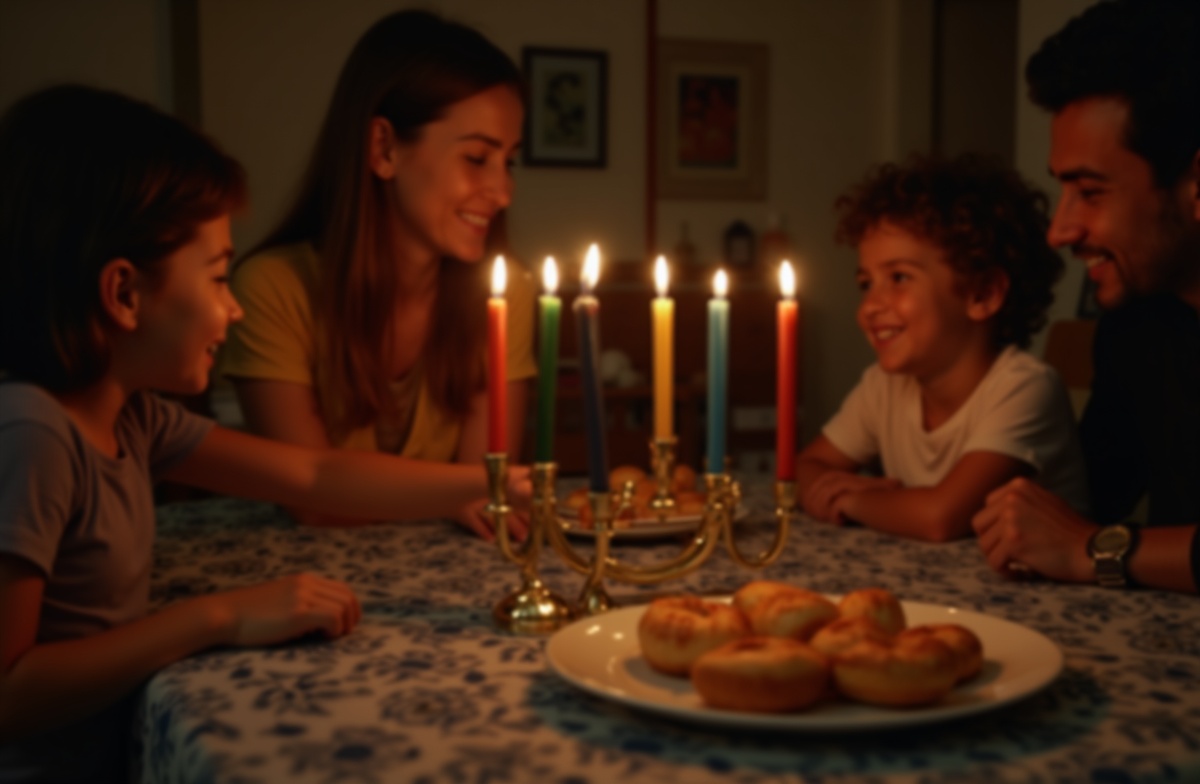
Today, Hanukkah is celebrated by lighting a special candelabrum — a hanukkiah. On each of the eight evenings, one additional candle is lit, kindled with the help of a helper candle called the “shamash.” This ritual is performed by a window to share the light of the miracle with others. Children play with a special spinning top — a dreidel, on whose sides Hebrew letters are inscribed. Traditionally, foods fried in oil are eaten, symbolizing that very miracle: latkes (potato pancakes) and sufganiyot (filled doughnuts). The holiday has a familial, joyful character, often accompanied by giving children small gifts or “Hanukkah gelt” (money).
Hanukkah in Israeli Society Today
In modern Israel, Hanukkah has moved beyond purely religious boundaries, becoming a national event. Cities are decorated with lights, public hanukkiahs are lit in squares, and concerts and street fairs are held. It is a time of sales, special TV programs, and cultural events. For many, it is also a period for summing up the year and planning for the future. Activity in the service and trade sectors increases: people look for services for organizing celebrations, buy gifts, and prepare treats.
Practical Aspects: Ads During the Holiday Season
The holiday period creates special demand for goods and services. It is an excellent time for business and private ads. You can sell themed souvenirs, hanukkiahs, game sets, or offer baking of traditional treats. Those planning a move or renting property should pay attention to the Real Estate section, as many use the holidays to search for new housing. Demand for temporary work in trade, logistics, and events also grows. And to get rid of unwanted items before the New Year, the Hand to Hand section is ideal.
Uniting the Country Through Communication
Hanukkah, with its message of light, resilience, and miracle, reflects the spirit of Israel — a country that has gathered people from all over the world. Understanding and participating in such holidays strengthens mutual respect. Our free classifieds platform contributes to this unity by erasing language boundaries. Whether posting an ad to sell a car in the Auto section, offering your professional services, or looking for employees, you gain a unique advantage: your text automatically becomes available in Russian, Hebrew, Arabic, and English. This not only increases your audience but also makes communication in multilingual Israeli society truly effective and simple. Let’s share light and opportunities!